
Why 90 Days of Sobriety Is an Important Milestone
Ninety days rarely looks like a movie milestone. It may look like a Tuesday alarm, a grocery receipt, three sober weekends becoming twelve, and the quiet realization that you now have memories of handling ordinary life differently.
That is part of why three months can carry weight: not because the calendar performs a medical magic trick on Day 90, but because enough real life has usually happened for patterns to become visible.
The number matters less as a finish line than as evidence of practice.
Ninety days sober matters because it turns a difficult beginning into something visible, countable, and worth recognizing. Around three months, many people have had enough time to experience sober routines across ordinary weekdays, weekends, stressful moments, celebrations, and changing emotions. The milestone can become a useful point for reflection: What is helping? What still feels hard? Who has been supportive? What do I want the next 90 days to look like?
Ninety days is not a universal medical finish line, and there is no rule that recovery should look a certain way by day 90. NIAAA research definitions use roughly three months as a boundary between “initial” and “early” periods of remission/recovery measurement, but that classification does not mean a person suddenly becomes safe, healed, or secure on a particular day. Recovery is personal and can involve many paths and forms of support.[1][2]
For many people, the best meaning of a 90-day milestone is simple: I kept choosing the next day, and those days became three months.
What Does 90 Days Sober Mean?
“90 days sober” generally means a person has gone about three months without alcohol or the substance they personally define as part of their sobriety. Some people count from the last day they used a substance. Others use a treatment start date, a date connected with a recovery decision, or another personally meaningful point.
There is no single recovery system that owns the milestone. Someone may reach 90 days through a 12-step fellowship, professional treatment, medication, therapy, a secular recovery community, faith, family support, self-directed change, or a combination of approaches. SAMHSA emphasizes that recovery is highly personal and can occur through many pathways.[2]
That matters because the value of 90 days should not depend on whether someone followed one particular program. The milestone can belong to the person who reached it.
Why Can 90 Days Feel So Significant?

1. It makes early progress visible
The first days of sobriety can feel very close together. A person may be focused on immediate choices: getting through tonight, changing a routine, calling someone, avoiding a trigger, showing up to an appointment, or simply making it to bed sober.
Ninety days creates distance from that starting point. It gives someone a visible marker that says, “This is not only an intention anymore. I have been practicing change.”
That does not erase difficulty. It does give the difficulty a history.
2. It is long enough to contain real life
Three months usually includes more than ideal conditions. It may include ordinary workdays, weekends, boredom, stress, social invitations, family tension, celebrations, loneliness, travel, paydays, holidays, or unexpected problems.
This is one reason the milestone can feel different from a short challenge. The person has not merely imagined a sober life; they have started living parts of one.
The details will vary. A person who spends 90 days in residential treatment will have a different experience from someone living at home, working full time, caring for children, or using community-based support. The point is not that everyone has “mastered” the same situations. The point is that 90 days creates enough lived experience to begin noticing patterns.
3. It creates a natural reflection point
A milestone is useful when it helps someone look backward and forward without turning recovery into a pass/fail test.
At 90 days, a person might ask:
- What situations have become easier?
- What situations still take a lot of energy?
- Which people make sobriety feel more supported?
- Which routines protect my time, health, or peace?
- What am I proud of that nobody else can see?
- Where do I need more help?
- What do I want to protect during the next three months?
These questions make the milestone practical, not just ceremonial.
4. It can strengthen identity without demanding perfection
In the beginning, “I am trying not to drink” may feel more believable than “I am a sober person.” Over time, repeated choices can begin to change the story someone tells about themselves.
Ninety days can be a point where the person starts to recognize evidence: they have declined drinks, changed plans, rebuilt mornings, attended meetings or appointments, talked honestly with someone, returned after a hard day, or found new ways to handle discomfort.
Identity can grow from actions. It does not have to arrive as a dramatic transformation.
5. It gives supporters a concrete moment to say, “I see your effort”
Recovery work is often invisible. Friends and family may see someone not drinking, but they may not see the internal decisions, changed routines, uncomfortable conversations, or effort behind that outcome.
A 90-day milestone gives supporters a reason to recognize that work without pretending they understand every part of it.
A short message can be enough:
“I know these 90 days represent a lot more than a number. I’m proud of the work you’re doing, and I’m glad I get to support you.”
The strongest recognition usually focuses on the person’s effort rather than on pressure to maintain a perfect future.
Is 90 Days a Medical or Scientific Turning Point?
Not in the sense of a guaranteed change that happens on exactly day 90.
NIAAA’s recovery research definitions categorize remission and cessation from heavy drinking by duration. In that research framework, “initial” extends up to three months and “early” spans roughly three months to one year.[1] This makes the three-month area meaningful for research classification, but it should not be turned into a promise that every person’s brain, body, cravings, mood, sleep, relationships, or relapse risk will follow the same calendar.
NIAAA also describes recovery as a long-term, individualized change process, often with improvement across health, relationships, quality of life, and other areas over time.[3]
So the safest way to talk about 90 days is:
It is a meaningful milestone and a useful reflection point, not a universal biological deadline.
What About “90 Meetings in 90 Days”?
Some people in peer-support communities recommend attending many meetings early in recovery, and “90 in 90” is a phrase you may hear. It can provide structure and frequent contact for people who find meetings helpful.
However, it should not be presented as an official requirement for every person in recovery. A.A.’s own FAQ states that members do not have to attend a set number of meetings in a given period; meeting frequency is a matter of individual preference and need.[4]
That distinction fits the broader Recovery Resources approach: offer support options without implying that one pathway is the only legitimate path.
How Can Someone Celebrate 90 Days Sober?

The best celebration matches the person. Some people want a quiet marker. Others want dinner, a meeting, a gift, a day outdoors, or a small group of people who understand what the date means.
Keep the celebration emotionally safe
Before planning a surprise, consider privacy. Not everyone wants their recovery shared publicly. A milestone can be deeply important and still be private.
If you are celebrating someone else, ask what they would enjoy. A simple question works:
“Would you like to do something for 90 days, or would you rather keep it low-key?”
Respecting the answer is part of the gift.
Give a 90-day sobriety coin
A 90-day sobriety coin can turn an invisible achievement into something a person can hold. The value is symbolic: the date, the number, the message, and the memory attached to it.
A coin can be especially meaningful when it includes:
- “90 Days” or “Three Months”
- a sobriety date
- a short personal message
- a recovery symbol such as a Tree of Life, butterfly, phoenix, lighthouse, mountain, or another design meaningful to the recipient
- wording such as “One Day at a Time,” “Every Step Forward Matters,” or “Starting Again Is Still Progress”
A.A. itself does not manufacture or sell sobriety chips, coins, or medallions, and customs vary by group and region.[5] That is why independent recovery coins should be described as commemorative gifts rather than as “official A.A. coins.”
Write a note that recognizes effort, not perfection
A meaningful 90-day card does not need to sound dramatic. Try to name what you respect.
Examples:
- “90 days is a lot of daily choices. I’m proud of you.”
- “You’ve built three months one day at a time. Keep protecting what matters to you.”
- “I see how much work is behind this milestone. Congratulations on 90 days.”
- “Every step forward matters. Today is worth recognizing.”
Avoid messages that create fear or pressure, such as “Don’t mess this up” or “Now you can never go back.” Support is stronger when it leaves room for honesty.
Choose an experience that supports the life being built
Consider a hike, breakfast, sports event, museum, road trip, favorite meal, creative class, fishing trip, game night, spa visit, or another activity the person genuinely enjoys.
The goal is not to make sobriety look entertaining every minute. The goal is to connect the milestone with a life that contains meaning beyond alcohol or substance use.
Mark the date privately
Some people prefer a quiet ritual:
- write a letter to their future self
- save a photo from day 90
- start a milestone box
- engrave a date on a coin or keychain
- make a list of “90 things I have learned” or “9 things I want to remember”
- donate, volunteer, or do something kind for another person
A private marker can be just as meaningful as a public celebration.
What Should You Give Someone for 90 Days Sober?
A good 90-day sobriety gift should do one of three things: recognize the milestone, support the person’s everyday life, or preserve the memory.
Useful options include:
- A 90-day sobriety coin - small, durable, and directly connected to the milestone.
- A personalized coin - add a date, initials, name, short phrase, or message.
- A coin gift set - pair the coin with a display case, card, or holder.
- A keychain or coin holder - practical for someone who wants to carry the symbol daily.
- A journal - useful for reflection without implying that journaling is required for recovery.
- An experience - dinner, a hike, tickets, a class, or a day trip.
- A comfort gift - coffee, tea, blanket, book, or something connected to a calmer routine.
- A handwritten letter - often more memorable than a generic “recovery” product.
The best choice depends on the person’s style and privacy. Do not assume they want recovery language displayed publicly.
If Someone Has Had a Setback, Does the Milestone Still Matter?
A setback does not erase what a person learned, changed, or experienced during earlier sober time.
Some people reset a sobriety date after returning to alcohol or another substance. Others use different language for their recovery. The important thing is to avoid using milestones as a weapon.
If someone returns to recovery after a setback, support can sound like:
“I’m glad you’re here. Starting again is still progress.”
NIAAA notes that recovery can be a long-term process and may include returns to heavy drinking for some people, especially in the first year.[3] A return to use can be serious and may require additional professional support, but shame is not a useful celebration strategy.
90 Days Is a Marker, Not a Finish Line
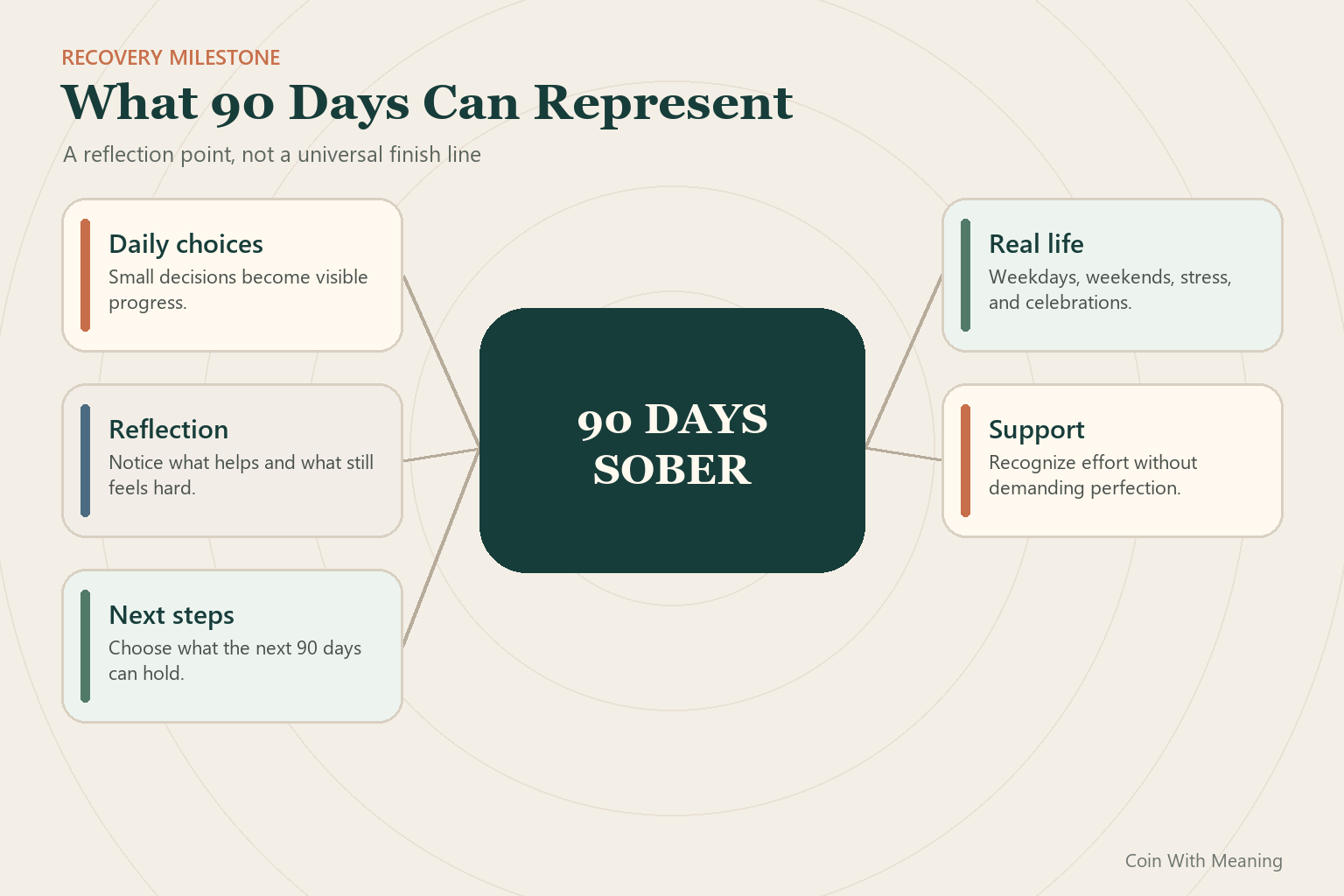
Three months of sobriety can hold a surprising amount of life. It can represent mornings that felt different, plans that changed, conversations that finally happened, boundaries that were difficult to keep, and ordinary days that quietly added up.
That is why the milestone matters.
Not because everyone should be “fixed” after 90 days. Not because one recovery program owns the number. Not because the next stage will automatically be easy.
It matters because progress deserves to be noticed.
A coin, a meal, a message, a private ritual, or a simple “I’m proud of you” can help turn the date into a memory. Then the person can keep moving forward in the way that fits their recovery.
Every step forward matters.
Frequently Asked Questions
Is 90 days sober the same as three months sober?
Usually, people use the phrases interchangeably, although 90 days and three calendar months are not always exactly the same number of days.
Why do people celebrate 90 days sober?
It is a recognizable early milestone that makes progress visible and creates a natural point for reflection, support, and celebration. It is not a universal medical finish line.
Is 90 days an official A.A. milestone?
Local groups may recognize 90 days and may use coins or chips, but A.A. does not manufacture or sell sobriety tokens, and customs vary among autonomous groups.[5]
Does A.A. require 90 meetings in 90 days?
A.A. states that members are not required to attend a set number of meetings in a given period. Meeting frequency is based on individual preference and need.[4]
What is a good 90-day sobriety gift?
A personalized sobriety coin, milestone gift set, handwritten letter, meaningful experience, journal, or coin holder can all work well. Choose based on the recipient’s preferences and privacy.
What should I write on a 90-day sobriety card?
Keep it specific and supportive. For example: “Ninety days is a lot of daily choices. I’m proud of the work you’re doing.”
Should I surprise someone with a sobriety celebration?
Only if you are confident they would welcome it. Recovery can be private, so asking first is often the more respectful choice.
Continue the milestone path: 90 Days Sober: Meaning | 90-Day Reflection | When Nothing Feels Different | Celebrate 90 Days
Related Reading
- What Is a Sobriety Anniversary?
- How to Celebrate 30 Days Sober
- 10 Meaningful Ways to Celebrate One Year Sober
- What to Write in a Sobriety Anniversary Card
Sources
- National Institute on Alcohol Abuse and Alcoholism (NIAAA), “Recovery Research Definitions.” https://www.niaaa.nih.gov/research/niaaa-recovery-from-alcohol-use-disorder/definitions
- Substance Abuse and Mental Health Services Administration (SAMHSA), “About Recovery.” https://www.samhsa.gov/substance-use/recovery/about
- NIAAA, “Support Recovery: It’s a Marathon, Not a Sprint.” https://www.niaaa.nih.gov/health-professionals-communities/core-resource-on-alcohol/support-recovery-its-marathon-not-sprint
- Alcoholics Anonymous, FAQ / What to Expect at an A.A. Meeting: “How often do A.A. members have to attend meetings?” https://www.aa.org/faq/how-often-do-aa-members-have-attend-meetings
- Alcoholics Anonymous, “I want to buy chips/coins/medallions. Are they available on aa.org?” https://www.aa.org/faq/i-want-buy-chipscoinsmedallions-are-they-available-aaorg
Editorial note: Sources support definitions and organizational practices. This article does not provide medical advice or claim that a specific biological change occurs on day 90.