
What to Write in a 30-Day Sobriety Card
You buy the card. You sit down with a pen. Then somehow the blank space inside becomes much more intimidating than the entire greeting-card aisle.
“Congratulations!” feels a little thin. “I’m so proud of you!!!” can suddenly sound like a performance review with confetti. And if the person has asked everyone not to make a big thing of their sobriety, even a loving message can start to feel like a spotlight.
At 30 days, the best card usually does less. It recognizes the milestone, says something true, and leaves the person room to own what comes next. You are not writing their recovery story for them. You are simply letting them know you noticed the work.
If you need wording for a different milestone or a broader starting point, use our main guide: What to Write in a Sobriety Anniversary Card. This page stays focused on the specific tone and questions that come with the first 30 days.
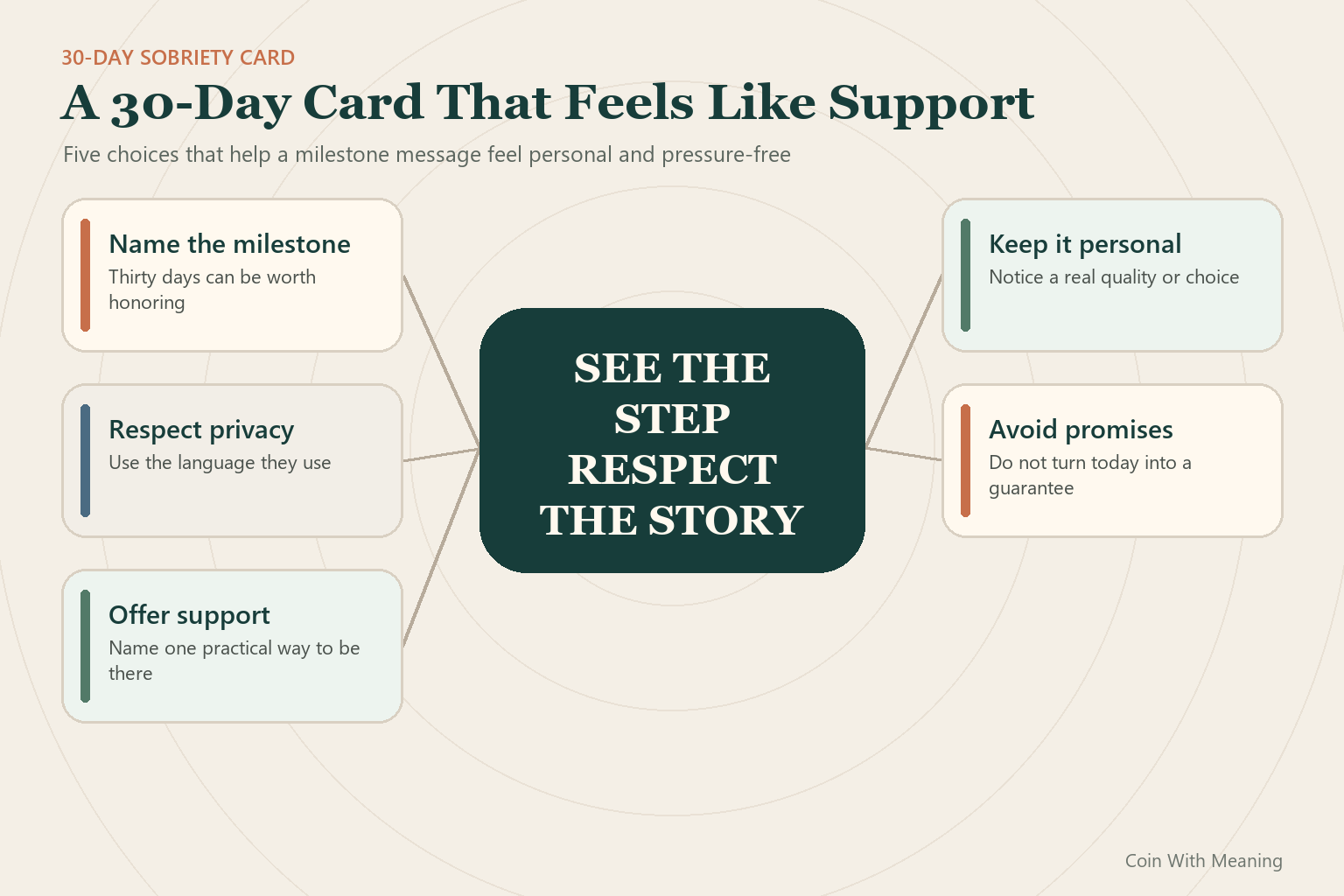
Thirty Days Can Be Both Big and Tender
A month may include four weekends, difficult evenings, first social events, changed routines, awkward questions, better mornings, or none of those things in the way outsiders expect. Recovery is personal, and there is no single emotional script for Day 30.
That is why a useful message does not tell the recipient how they should feel. It does not call them “fixed,” promise that everything is different now, or immediately move the goalpost to 60 or 90 days.
Reframe: a 30-day card is not a progress report. It is a small act of witness.
A Simple Formula That Rarely Goes Wrong
Use four parts:
- Name the milestone. “Thirty days is worth recognizing.”
- Say something specific. Mention courage, honesty, consistency, presence, or another quality you have genuinely seen.
- Offer support. Keep it warm rather than managerial.
- Remove pressure. Let today be enough.
For example: “Thirty days is worth recognizing. I’ve seen how intentionally you’ve been showing up for yourself, even on ordinary days. I’m proud of you, and I’m here for whatever comes next.”
Short 30-Day Sobriety Card Messages
- Thirty days. A lot of individual choices. I’m proud of you.
- One month is worth a moment. I see the work behind it.
- Thirty days strong—and still allowed to take it one day at a time.
- I’m proud of the life you’re building, not just the number.
- Every step forward matters. Happy 30 days.
- No pressure about the next milestone. Today counts.
- I see your courage, your honesty, and your effort.
- Thirty days is not small. I’m glad to celebrate it with you.
For a Friend

Friendship often gives you permission to sound like yourself. The message can be warm, plainspoken, even lightly funny if that is already how the two of you communicate.
- Thirty days looks good on you. Proud of you, friend.
- I know this month has contained more than the calendar shows. I’m proud of you.
- No giant speech. Just: I see you, I’m proud of you, and I’m here.
- Thirty days. That deserves good coffee and at least one excellent snack.
Humor should never make drinking, relapse, or the person’s past the joke.
For a Partner or Spouse
A partner may carry their own relief, fear, and history. Those feelings are real, but the anniversary card is not the best place to make the recipient carry all of them.
- I’m proud of the work you’re doing for yourself. I love being beside you as you build what comes next.
- Thirty days is yours. I’m grateful you let me share this moment with you.
- I love you, not a number on a calendar. I also know this number matters, and I’m proud of you.
If trust is still rebuilding, do not force reconciliation into the card. Support and boundaries can exist at the same time.
For a Son or Daughter
Parents can easily write from relief: “We finally have you back.” That may express a real feeling, but it can also make the child responsible for repairing the parent’s fear on their milestone day.
Center the person instead:
- Thirty days is worth honoring. I’m proud of your courage and the way you keep showing up.
- I love you. I respect the work you’re doing, and I’m here to support you without taking the journey away from you.
- I see your effort. You do not have to prove anything to me today.
For a Parent
- Thirty days is a meaningful milestone. I’m proud of you and grateful to celebrate it with you.
- I see the consistency behind this month. You deserve to feel proud.
- Thank you for letting me be part of this chapter in the way that feels right to you.
For a Coworker
Privacy matters. If someone has shared the milestone with you privately, do not turn it into office news.
- Congratulations on 30 days. Wishing you continued strength and good things ahead.
- Thirty days is worth recognizing. I’m glad for you.
- Proud of you—and keeping this exactly as private as you want it.
If They Are Starting Again

A restarted 30 days can hold extra emotion. Avoid “this time better be different” language, comparisons with an earlier streak, or anything that turns the card into a warning.
Reframe: starting again does not erase the courage required to start again.
- Thirty days, again—and still meaningful. I’m proud of you for continuing.
- This milestone belongs to the life you’re choosing now. I’m glad you kept going.
- Starting again is still progress. Thirty days is worth recognizing.
What Not to Write
- “Now don’t mess it up.”
- “Only eleven months until a year.”
- “You’re finally fixed.”
- “I knew you could do it if you really tried.”
- Anything that inventories past harm in the middle of a celebration.
- Anything that publicly labels the person without permission.
Encouragement becomes pressure when it makes the recipient responsible for protecting the giver from future fear.
Can You Use a Quote or Scripture?
Yes, when it actually fits the person. Use faith language if the recipient uses faith language. Use a recovery phrase if it belongs to their recovery path. A private saying between the two of you may be more meaningful than a famous quote.
How to Personalize the Card
Add one detail that could not have been written for anyone else:
- a quiet morning routine you have noticed;
- a new hobby or old interest returning;
- a quality they have shown under stress;
- a private phrase;
- a specific memory from this month;
- something about who they are beyond recovery.
That last one matters. People in recovery are still whole people. A good card sees more than their relationship with alcohol.
Pairing a Card With a Gift
If the recipient likes milestone keepsakes, a 30-day coin, personalized date token, small journal, favorite book, meal, or experience can accompany the card. If they dislike recovery-themed objects, let the card carry the milestone and choose a normal gift that fits their life.
The gift should not function as a contract for future sobriety.
If you are writing a 30-day sobriety card, there is a good chance you are also wondering whether to give something with it. It does not need to be expensive or dramatic. At this stage, a small object that says I noticed this milestone can feel more appropriate than a large celebration.
Not sure what fits? Start with our Meaningful 30 Days Sober Gift Ideas, or read What Does 30 Days Sober Mean? if you want to understand the milestone before choosing a gift.
A Small Keepsake for “One Day at a Time”
For someone who likes tangible milestone reminders, a sobriety coin can sit beside the card without turning the moment into a huge ceremony. The message matters more than the object; the object simply gives that message somewhere to live after the card is put away.

If You Want Something Warmer and Less Formal
A floral or affirmation-style coin can work when the recipient would prefer encouragement over a traditional recovery-medallion look. It can be paired with one sentence from your card rather than a big speech.

And if a recovery-themed gift would make the person uncomfortable, skip it. A thoughtful meal, book, coffee, flowers, or time together can carry just as much meaning. The best gift is the one that fits the person, not the milestone checklist.
A Fill-in-the-Blank Template
“Thirty days is worth recognizing. I’ve noticed [specific quality or change], and I admire the way you [specific action]. I’m proud of you. I’m here for you [supportive phrase], with no pressure about what comes next.”
Frequently Asked Questions
What should I write in a 30-day sobriety card?
Recognize the milestone, name something specific you admire, offer support, and avoid pressure or predictions.
Is 30 days sober a big enough milestone for a card?
Yes, if the person values milestone recognition. Thirty days can represent a meaningful stretch of daily choices.
Should I say “congratulations”?
You can. Pair it with something specific so the message feels personal rather than generic.
What if the person keeps recovery private?
Give the card privately and avoid visible recovery wording, public posts, or details they have not chosen to share.
What if 30 days comes after a relapse or restart?
Recognize the current milestone without shaming the setback or demanding future perfection.
Should I give a gift with a 30-day sobriety card?
You can if the person enjoys milestone recognition. Keep it proportionate and personal: a small sobriety coin, journal, book, favorite meal, or shared experience can work well. If they prefer to keep recovery private, choose something that does not publicly label the milestone.
Final Thought
You do not need to write the perfect thing. You need to write something true enough that the person can read it without feeling graded.
Thirty days. I see you. I’m proud of you. Today counts. That is often plenty.
Continue the milestone path: What Does 30 Days Sober Mean? | Meaningful 30 Days Sober Gift Ideas
Related Reading
- What to Write in a Sobriety Anniversary Card
- What to Write in a 90-Day Sobriety Card
- What to Write in a One-Year Sobriety Card
Sources & Further Reading
- SAMHSA. Working Definition of Recovery from Mental and/or Substance Use Disorders.
- NIAAA. Alcohol Treatment: Many Routes to Recovery.
Looking for a physical milestone gift? Browse 30 Day Sobriety Gifts for milestone coins and personalized keepsakes.
More Help for the 30-Day Milestone

Choose a celebration that feels personal, private, and low-pressure.

Find a gift or experience that fits the person instead of forcing a recovery script.

Understand the meaning of the first month before deciding how to mark it.