
What Keeps People Sober for 10, 20, or 30 Years?
When someone says, “I've been sober for thirty years,” our brains immediately want the trick.
Surely there is one hidden setting they found somewhere around year seven.
Meetings every day? Meditation? Exercise? A sponsor? Therapy? Medication? Never going near a bar? Becoming mysteriously excellent at drinking water?
The frustrating—and useful—answer is that there is no single secret.
People who stay sober for decades are not necessarily the people who found the perfect system. Often, they are the people who kept adjusting the system when life changed.
NIAAA describes recovery as a dynamic, long-term process connected with alcohol outcomes, functioning, quality of life, and well-being. SAMHSA emphasizes that recovery is person-driven and can happen through many pathways.
Different people use different tools.
But several patterns show up again and again.
They build a life that becomes worth protecting
Early recovery often begins with subtraction: stop drinking, avoid a risky situation, get through tonight.
Long-term recovery eventually needs addition.
Family. Work. Art. Health. Faith. Friendship. Service. Travel. Education. Pets. Community. Quiet mornings. A garden that somehow produces fourteen zucchinis at once.
The details vary.
The deeper shift is that sobriety stops being only about escaping the consequences of alcohol and becomes connected to something the person actively wants to keep.
A sustainable sober life is not only the absence of alcohol. It is increasingly the presence of reasons to stay present.
They stop asking one tool to solve every problem
A meeting cannot treat every medical condition.
Medication cannot repair every relationship.
Exercise cannot process every trauma.
Faith cannot replace emergency medical care.
Therapy cannot make every environment safe.
Long-term recovery often becomes more durable when people use the right tool for the right problem.
Someone may combine professional treatment, medication when appropriate, peer support, family, faith, exercise, therapy, community, or other practices.
Decades of life contain more than one kind of problem. It makes sense that decades of recovery may require more than one kind of support.
They keep somewhere honesty is possible

The person does not have to be a sponsor or therapist. It could be a spouse, doctor, friend, peer group, faith leader, recovery coach, or family member.
The important thing is having somewhere to stop performing competence.
At twenty years sober, it can feel embarrassing to say, “I'm struggling.” You may be the person other people call. You may have become the example.
That role can quietly become isolating if it convinces you that asking for help would somehow invalidate the years behind you.
A strong support system does not have to be large. It has to be usable.
They learn their warning signs—and believe them
Long-term recovery becomes increasingly personal.
One person notices isolation first. Another notices bad sleep. Someone else starts romanticizing old drinking stories. Another begins overworking, skipping meals, or pulling away from the people who usually know them best.
Possible warning signs can include:
- persistent sleep disruption;
- escalating stress or grief;
- withdrawing from supportive people;
- romanticizing past drinking;
- hiding thoughts about alcohol;
- abandoning several healthy routines at once;
- using another substance or behavior in a concerning way;
- believing that asking for help would be humiliating after so many years.
The skill is not becoming a person who never changes.
It is shortening the distance between noticing change and responding to it.
They adapt when life changes
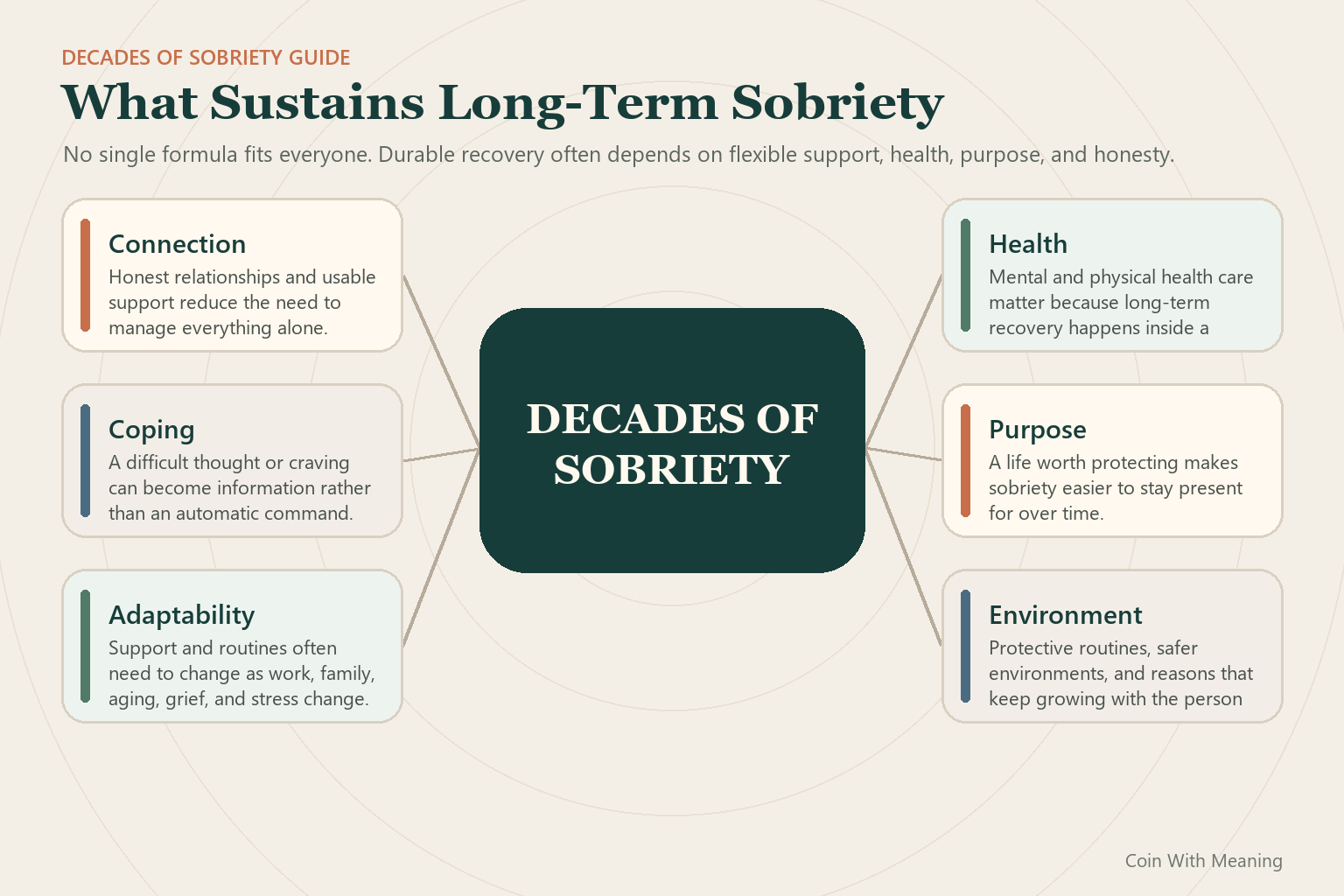
The strategy that worked at twenty-eight may not fit at fifty-eight.
Marriage, parenthood, divorce, bereavement, retirement, chronic illness, caregiving, relocation, medication changes, financial stress, and aging can all change what a person needs.
Long-term recovery is not rigid repetition. It is responsive stability.
If risk rises, support can rise.
If an old tool stops fitting, another can be added.
If mental-health symptoms appear, they can be treated as health concerns rather than character flaws.
Adaptability may be one of the least glamorous and most useful long-term skills.
They treat stress as information, not permission
Stress can raise the risk of returning to old coping patterns.
But “stress made me do it” removes too much agency, while “I should be tougher than stress” removes too much reality.
A more useful middle ground is:
Stress changes my risk, so I change my support.
That could mean more therapy, fewer obligations, better sleep protection, a medication review with a clinician, more contact with supportive people, taking time off, or skipping an environment that feels unusually risky.
Long-term recovery is often less about being tougher and more about responding earlier.
They allow recovery identity to evolve
Some people proudly identify as sober for life. Some say they are in recovery. Some remain deeply connected to A.A., SMART Recovery, faith, or another community.
Others eventually think about alcohol very little and do not make recovery a public identity.
A changing identity is not automatically a threat.
The useful question is whether the person's current identity still supports honesty, health, and safe choices.
You do not have to perform recovery in one approved way to protect it.
They take mental and physical health seriously
Long-term recovery happens inside a body that keeps aging and a life that keeps happening.
Depression, anxiety, chronic pain, sleep disorders, injury, illness, or other health conditions can appear years later. Some people may benefit from medications used to treat alcohol use disorder, and treatment needs can change over time.
Returning to professional care after years of stability is not a failure.
If someone has returned to sustained heavy alcohol use, they should not assume stopping abruptly is medically safe. Alcohol withdrawal can be dangerous for some people, and qualified medical assessment may be necessary.
They do not treat every difficult thought like an instruction
A person can remember alcohol fondly without deciding to drink.
They can dream about it, walk past an old place, feel an urge after a loss, or have a thought after many quiet years.
A thought is not a command.
It may be information: I am grieving. I am exhausted. I am lonely. I need help. Something changed.
Long-term coping often looks less like panicking about the thought and more like responding to what the thought may be pointing toward.
Their reasons grow with them
Someone may first get sober for their children.
Twenty years later, those children may be adults.
If the reason for staying sober never expands, major life transitions can leave a strange vacuum.
Reasons can grow: health, peace, integrity, family, freedom, creativity, financial stability, spirituality, reliability, or simply liking the life that exists now.
“My life works better this way” is not a small reason.
Some give back. Nobody owes it

For some people, helping others creates meaning and connection. Peer recovery support can be powerful because lived experience offers a kind of recognition that is difficult to manufacture.
But service is not a debt.
Nobody owes public vulnerability in exchange for sobriety.
A person can maintain long-term recovery privately and still be doing something deeply worthwhile.
They do not turn the day count into a test of worth
A sobriety date can be meaningful. Milestones can help make invisible continuity visible.
But a number is not the only evidence that a life changed.
Other evidence may be quieter: fewer crises, more honest conversations, safer choices, repaired finances, better healthcare, different parenting, stronger boundaries, greater self-respect, or the ability to experience discomfort without automatically escaping it through alcohol.
If a person returns to alcohol, their milestone framework may change. The skills, relationships, knowledge, and years already lived do not vanish from history.
Yes, people with decades sober still have bad days
Of course.
They can be angry, jealous, impatient, lonely, anxious, tired, selfish, confused, or spectacularly bad at communicating on a Wednesday.
Recovery is not a personality transplant.
The difference is not that difficult emotions disappear. It is that those emotions no longer have to automatically lead to the old coping behavior.
What can someone early in recovery learn from decades of sobriety?
Do not try to live year twenty on day twenty.
The person with decades sober did not complete the entire journey in advance.
They made thousands of smaller adjustments.
The useful lesson is not “copy my exact program.”
It is:
- build support you can actually use;
- make your environment safer;
- take mental and physical health seriously;
- learn what raises your risk;
- create reasons to stay that are bigger than fear;
- change your support when life changes;
- ask for help before a crisis when possible;
- let life become larger than the problem that brought you into recovery.
Frequently Asked Questions
What is the biggest predictor of long-term sobriety?
There is no single factor that guarantees decades of sobriety. Long-term outcomes are influenced by interacting factors such as treatment, social support, health, environment, coping skills, severity, and life circumstances.
Do people with decades sober still need support?
Many do, although support may look different over time.
Is long-term recovery possible without AA?
Yes. A.A. is one pathway among many, and SAMHSA recognizes multiple recovery pathways.
Can someone be sober for decades and still have cravings?
Yes. Some people rarely experience meaningful cravings after long periods; others may have occasional urges, particularly during stress or exposure to old cues.
What should I say to someone celebrating 30 years sober?
Recognize both the milestone and the life behind it. A simple message can be: “Thirty years is an extraordinary amount of life lived with intention. I'm honored to celebrate it with you.”
The secret is that there is no single secret
People who stay sober for ten, twenty, or thirty years are not one type of person.
They do not all use the same program.
They do not all believe the same things.
They do not all feel the same way about sobriety.
What many long-term recovery stories share is responsiveness.
When life changes, they adapt.
When support is needed, they reach for it.
When a tool stops fitting, they find another.
When recovery becomes stable, they let life grow around it.
The goal is not to become a person who never needs anything. The goal is to know how to protect what matters.
Related Products
Continue the milestone path: Ten Years Sober
Continue the long-term recovery path: Browse Sobriety Guides | Long-term recovery overview | Community and giving back | Purpose in a sober life
Related Reading
- 20 Years Sober: What Long-Term Recovery Can Look Like
- Does “One Day at a Time” Still Matter After 20 Years Sober?
- Meaningful Gifts for Long-Term Sobriety Milestones
- What Happens After One Year Sober?
This article is general educational guidance, not medical advice. If alcohol use has resumed, withdrawal risk is possible, or mental-health symptoms are rising, seek qualified professional support.
Sources
- National Institute on Alcohol Abuse and Alcoholism (NIAAA), NIAAA Recovery Research Definitions
- NIAAA, Recovery from Alcohol Use Disorder Overview
- NIAAA, Support Recovery: It's a Marathon, Not a Sprint
- Substance Abuse and Mental Health Services Administration (SAMHSA), About Recovery
- SAMHSA, Peer Support Workers for Those in Recovery